
Is the Sci-Fi Zeitgeist Finally Shifting
Away From Guilt-Ridden Tales of
Climate Change Catastrophes?
Blazing Reader,
Science fiction authors need "to stop writing about climate change," warns Thomas Umstattd Jr. (host of the world's longest-running podcast on novel marketing), in his article, The Sci-Fi Zeitgeist Has Shifted.
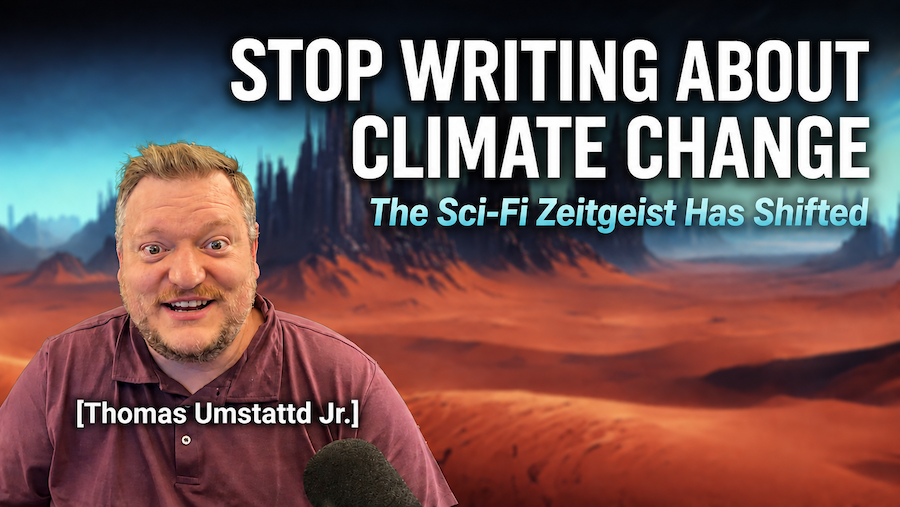
For the last forty years, climate change restrictions and catastrophes have been the backdrop for many (if not most) near-future science fiction stories set on Earth. Collapsing Empire by John Scalzi and Steven Spielberg's Artificial Intelligence have been making authors and filmmakers rather wealthy by telling dystopian tales of an Earth devastated by automobile emissions.
But times are thankfully changing faster than Grok can 4x your favourite banana buckwheat pancake recipe.
As Umstattd writes:
"AI needs electricity, particularly during peak hours. So, the big tech companies that were making money collecting government subsidies for green technology now see reusable energy as a competitive disadvantage. In the long term, companies with the cheapest electricity will make the most from AI, and green energy is still more expensive per KWH."
With China building two coal burning plants every week (Grok has a lot of recipes to recalculate!) we'll see pretty soon whether increased CO₂ output leads to global flooding or global greening (after all, trees really, really like carbon).
Either way, more and more readers around the world suspect that climate restrictions, taxes, and penalties were never really about helping the environment but rather a means to control the population.
Umstattd writes:
"All human activity results in CO₂. Every breath you take and every bite of food you eat involves you releasing CO₂ into the air. That means control over CO₂ is a proxy for control over all human activity. If I can control your carbon output, I can control every aspect of your life.
"Readers are starting to see climate change as a proxy for control. So, unless you are writing a dystopian novel where the government uses the fear of climate change to control the population, the classic climate change story won’t vibe with readers like it used to."
It's refreshing to see that my novel, All the Humans Are Sleeping, was a few years ahead of this shifting zeitgeist.
In the epigraph to chapter 11.05, Dr. Marta Wink has this to say about the so-called "scientific consensus" on climate change:
“A strange trend in the late twentieth and early twenty-first century involved blaming human-generated carbon emissions for the inevitable and natural phenomenon of ‘climate change.’ Oddly enough, the climate had always been changing, sometimes drastically, as was seen during the medieval warming period (circa 950-1250). But mankind always seemed to be looking for excuses to hinder their own progress.”
Don't humans already have enough problems — environmental and otherwise — to be worried about angry weather gods sending the next flood upon senior citizens for turning up their air conditioner?
In many ways, like COVID-19, the climate change narrative sounds more like fantasy than science fiction.
John C.A. Manley
P.S. For a free sample of the first 24 chapters of my narrative-challenging novel, All the Humans Are Sleeping, head on over to AlltheHumansAreSleeping.com.
P.P.S. And to read the rest of Thomas Umstattd Jr.'s brilliant article on how and why "The Sci-Fi Zeitgeist Has Shifted" (or listen to the podcast adaptation), visit AuthorMedia.com.
 John C. A. Manley is the author of Much Ado About Corona, All The Humans Are Sleeping and other works of philosophical fiction that are "so completely engaging that you find yourself alternately laughing, gasping, hanging on for dear life." Get free samples of his stories by becoming a Blazing Pine Cone email subscriber.
